Showing posts with label che guevara. Show all posts

Wednesday, December 2, 2009

(new) Muchas Gracias


There was still no sign of our etickets in my email. But rather than phone South African Airways again, I decided to take a break. It was time for a trip out of town, something we hadn’t done in a while. The phone call to SAA could wait until tomorrow.

Cordoba was an old Jesuit town, even older than the missions we’d visited in Bolivia. And many of those old Jesuit missions still existed in town and even more could be found in the small towns just outside the city. We were headed to one of them called Alta Gracia. But not just for the mission, we’d certainly seen enough of those, but because Alta Gracia was the childhood home of Che Guevera which Adrian was really excited about.

Getting there was easy. We caught a bus from the bus station and an hour later we were in the town. It was bigger than we expected and we had no map. So once we saw what looked like the main street (lots of shops, old signs) we got off and hoped that there would be some signs to point is in the right direction. And we were obviously getting good at figuring our way around these Latin American city because we stumbled upon the old plaza and the original Jesuit mission (called an estancia here) easily. Unfortunately despite the sign that said it was open for another hour, it was closed for the afternoon siesta. We checked out and the small church (photo above) that was open. And then popped into the tourism office just across the street in the old clock tower. With the free map and the help of the woman at the desk we were off to chase Che.

The Gueveras had moved to Alta Gracia when Che was just a 6 and lived there off and on for the next 10 years. The museum was housed in the old family home that had been and still was the leafy rich part of town just behind the fancy-schmancy resort hotel. The museum was small and contained lots of information related to his youth, including photos and copies of his school reports as well as postcards, maps and writings relating to his youthful motorcycle journey across Latin America that looked an awful lot like ours.. They even had a model of the motorcycle he rode on the famous legs and the bicycle he used for another less famous one. Adrian ran around with glee while I was happy with the free admission price.

Somewhere in the middle of the house, a familiar voice called out. Fancy meeting you here. It was Stuart from Santa Cruz but without Max who was still back in Bolivia awaiting a money transfer so he could pay his hostel bill. The two lads were at the tail end of the trip and while Stuart still had cash, Max had overextended himself. It had been 3 months since we’d first met them and another month or two since we’d bumped into them in Uyuni and here we were meeting up in Argentina. We chatted for a bit and then left each other to explore the museum before saying goodbye probably for the last time.

The mission was still closed so we stopped at a café for a little lunch of giant lomitos (beef sandwiches) which killed just enough time until the mission opened as well as filling our stomachs.

Then it was time to walk around the mission. There was a small museum to start filled with a mish mash of old objects from the history of the mission from a Jesuit farming estate up to the time of its life as the home of the local governor. The most interesting was a chair fashioned from the pelvic bones of a cow. Gruesome and yet totally cool – I think Adrian and I both decided we wanted one. The mission itself was lovely and nice and thankfully completely different from the ones we’d visited way out in nowhere Bolivia. But what was just as nice was the free postcard that the attendant gave me when we left. She saw me looking at them and just told me to have one as a regalo. A small gift but it was definitely the thought and gesture that counted and meant a lot. And with a alta gracia (high thanks) we said adios to Alta Gracia.

Thursday, October 1, 2009

Chasing Che to the end.


Why were we in Samaipata? I blame Adrian. As long as we’d been on the road he’d been asking folks who’d been to Bolivia if they’d been to the spot where Che Guevera was captured. The unanimous response was no. Easy to see why. Santa Cruz is not high on traveller’s lists and if it is it’s only as a place to catch the train to Brazil. But we weren’t headed for Brazil just yet. No, we had headed to Samaipata to trace Che Guevera’s last steps. Depsite trying to find out how to get there on our own (the concensus, not easily), we had relented and forked out big money for a private car/driver/and guide all the way out to the El Churo ravine where he was captured, La Higuera where he was executed and Vallegrande where he was buried under the airport runway. It was also the price we paid to get up at stupid o’clock. The early morning was made easier by the fact that the kind owners of La Posada had arranged for someone to make us breakfast and a bag lunch before we left. Then it was off with our guide Rufo to chase che.

We left in the dark at 5am sharp as Rufo navigated the roads at top speed. I found it better to close my eyes and felt myself drifting off, only waking as the paved road became deeply rutted dirt track for a few metres before switching back to pavement. I’d like to think that there was some sort of road improvement taking place but I believe it was just a plan to spoil my sleep attempt. In the front seat Adrian snored on. Just after 7am we arrived in Vallegrande. Rufo stopped at a market so we could pick up some food and drinks warning us that there would be very little available further on. Although it was early, the town was already awake but we’d have to wait to explore it until we returned on our way back to Samaipata.

Any attempts to fall back asleep were abandoned on our way out of Vallegrande. The road was now an honest to goodness dirt one. We passed signs announcing La Ruta de Che and pointing down narrow paths to tiny villages. We were getting closer and Adrian was getting more excited and I was relieved that his fanaticism hadn’t sent us on the five-day trek through these mountains. In another hour, we reached Pucara which I had read (in the literature of various tour companies) was a pleasant picturesque colonial town. It was a small village and colonial but falling apart and not really what I would call picturesque. Rufo once again promised we would stop here on our way back for photos but other than crumbling adobe buildings and dirt streets I didn’t see what there was to take pictures of.

Now the road was even worse and we were the lone vehicle trying to get through the mountains here. I’m glad we had chosen this private car route as I’m not sure how we would have gotten past Pucara or even Vallegrand. The scenery was quite stunning though. Deep valleys, high mountain tops and even sun poking through the clouds – something we hadn’t seen in a while. When we were at the top of a mountain, Rufo pulled over on the road and I thought it was time for a photo opportunity. Nope, Rufo explained pointing down to the ravine below. It was time to walk to El Churo, the place where Che was ambushed and captured by the Bolivian army (and CIA, depending on who you asked). I had imagined the hike to this spot would be a nice leisurely stroll that was flat. It was obvious I’d forgotten we were in bumf*cknowhere Bolivia because the path Rufo pointed to was more of a donkey trail that went almost straight down. It was full of sand and loose rock and since I didn’t trust the grip on my shoes I was making my way down slowly while Adrian seemed to run down the mountain. Rufo took his machete and cut a walking stick for me which helped as we negotiated some truly steep paths. We passed through a herd of cows grazing on the thorny underbrush on the hillside and crossed over some streams, walking down for about an hour. The entire time I wondered to myself how we were going to get back up. Finally we scrambled over a mass of fallen trees and over the final slippery river rocks and reached a clearing with the familiar silhouette nearby.

The middle of the clearing was marked by the familiar yellow star surrounded by benches in a circular (erm, perhaps sickle-shaped) pattern. Adrian immediately stood in the circle with a big smile on his face. Rufo pointed to various rocks nearby acting out Che’s last stand as I translated for Adrian. Then it was Adrian’s turn to act it out as I snapped pictures. There was Adrian fighting off the army in front of us until he realized he was surrounded on all sides. Then there was Adrian running to another rock for better cover but leaving his leg exposed to enemy snipers. There was Adrian shot in the leg throwing his stick, I mean gun, aside in surrender. As I snapped away Rufo asked if I wanted a picture of both of us. No, I’m just here to translate, I told him. This day is all for Adrian. Who was now busy writing his name on a tree. Adrian was here indeed.

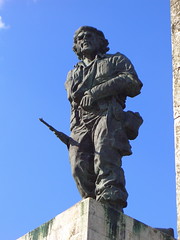
After a brief rest on the benches, it was time to head back up. It was tough although not as bad as other times since we weren’t at altitude. I lagged behind and Adrian and Rufo had the benefit of extra long breaks as they waited for me to catch up. Rufo tried to encourage me by telling me Che had done this for and he had asthma so I could do it. I wheezed that I had asthma too and he suggested that we take a longer break in the shade this time. It helped a bit but it still took 1.5 hours to climb back up to the road. Finally. All this for Adrian – I think he owes me one. We ate the leftovers from breakfast and then headed down the road to the village? town? hamlet? of La Higuera. It wasn’t more than 5 homes and a handful of storefronts but it was important as the place where Che was held for two days before being executed. The little town had made the most of it. In the square was a small bust of Che next to a giant statue of Che beside another bust of Che next to a cross (photo above). Che grafitti and murals dotted the walls of the small schoolhouse and shops. And we were lead to the Che museum in the replica one room schoolhouse where he had been held captive. Since Bolivia really had no interest in Che until about 10 years ago there was nothing original from his capture but the town did its best with a small timeline and pictoral history of his life and death. Even with Adrian hanging on every word, it only took about 20 minutes to take it all in. Then it was back in the car to retrace our steps.

We passed through Pucara and I declined Rufo’s offers to stop for photos – it didn’t look any nicer the second time around plus I was still exhausted from that “little” hike. However, I was kicking myself for not asking to use the bathroom. While the boys were able to pull over at anytime on the road, I was starting to get a bit uncomfortable in the back. Half way between Pucara and Vallegrande, Rufo read my mind and found a small collection of bushes for me to hide in. Of course I had to kick out the dozens of unhappy chickens hanging out in them and ignore the loud buzzing of what was apparently a nest of bees or wasps nearby. Better to risk a few stings than a burst bladder – and I luckily managed to avoid both.

We arrived in Vallegrande and immediately headed to their Che Museum. But before we could continue to chase Che we were given a guide tour of the small archeological museum. It was more of what we’d already seen at Tiwanaku but I was impressed that Adrian stayed put as the guide took us through the pots and bones when upstairs the definitive Che museum was waiting. However this definitive museum was almost an exact copy of the displays in La Higuera. But there was an extra group of photos of various people standing beside Che’s body when it had been brought to Vallegrande as well as a another outlining the ’97 discovery and unearthing of the mass graves containing the remains of Che and the other 13 killed in the final battle. We lingered as much as we could trying to get our money’s worth and then found Rufo to take us to the next sites.

A man from the museum now accompanied us as we headed to the old airport. Actually it was still the airport but I don’t think Vallegrande has seen any flights since the helicopter that flew Che’s body here, especially since the dirt airstrip was cut short by a mausoleum. Inside were more of the same photos lining the wall and in the middle was a hole in the ground with cement markers showing who’s body came out of what indent. It’s all rather grim in retrospect but at the time Adrian’s excitement made us forget what we were looking at. Although we had the museum guide with us (which we had to pay for), there was an English speaking guy hanging around the mausoleum. His name was also Ernesto Guevera (honest he claimed) and he was from near Santa Clara in Cuba, one of the group of students tending to the grounds. Yup Cuba sent a group of 20 here to maintain the grounds. He led us through the photos and was pleased that we’d been to Cuba and seen the Che stuff around Santa Clara. He also told us about meeting one of Che’s daughters, Aleidita, who told him the story of when Che in disguise came to visit the family for the last time before heading to Bolivia. The children were merely told it was a friend of their father’s visiting but the young Aleidita noticed that this stranger wouldn’t stop looking at her. “I think daddy’s friend is in love with me she told her mother.” Although cute it’s also a sad story, knowing that was the last time she saw her father. The mausoleum had a wall similar to the one in Santa Clara with tombstone like memorial markers for all the guerrillas who died in the battle. We thanked Ernesto for his time and left him to continue touching up the paint in the mausoleum and he thanked us for the opportunity to practice his English.

Back in the car, Rufo and guide now took us to another field on the outskirts of town. It was the grounds of the Rotary Club but just behind the swimming pool was a small parkette full of more Cubans, painting and weeding the plot. This was home to the other mass grave where the 7 had been buried including Tania, the lone woman guerilla who fought along side the men. It was a more like a cemetery and despite the flower beds it wasn’t a place we wanted to linger so we got back in the car for our final stop. We pulled up in front of the town hospital and the guide took us past murals around back to an outbuilding that had once housed the hospital laundry. There in the open air building was the original laundry sink where the Bolivian army had laid out Che’s body for display – this wasn’t so that people could pay their respects but an army displaying the spoils of war. After they let the international press in to take photos of the body, they cut off Che’s hands and sent them to Cuba as a sort of take that, Rufo and the guide explained. And the sad fact is that although lots of locals filed by to check out the body no one really knew who he was at the time. But not now. These days the laundry was a mecca and the walls were covered in names and messages from people from around the world who had come to pay their respects. Since we were accompanied by a man from the museum I stopped Adrian from adding his own scrawl but snapped as many photos as I possibly could for him.

And with that we were done chasing Che.

Rufo now suggested we now chase some food. That proved to be hardest search of the day (minus the hike of course) as it was after 4pm and many places were closed between lunch and dinner. He did find a small Chinese place open and for the price of one meal back in Samaipata we had three. Then it was back in the car for the long ride back. We arrived back at the hostel at 7:30 pm and settled up with Rufo. Chasing Che had been a long day and now it was time to chase some sleep.

Wednesday, February 6, 2008

Chasing Che

January 23, 2008 - Playas del Este
Adrian and I only had two must do's on our agenda. See Havana. And chase Che Guevara.
You see ever since our trip to Buenos Aires, 8 years ago, Adrian has been somewhat obsessed with Che Guevara. Why? I'm not sure and I don't think Adrian is either. But slowly we've been tracing his footsteps around the world, by accident. First to BA then to Peru and now to Cuba. We can only hope that our trip to Bolivia will end better than his.

In Cuba, chasing Che meant a pilgrimage to Santa Clara, but how to get there was our problem. Car rentals were $300. Buses took at least 7 hours. And both of these options were not working with our time and money limitations. Thankfully, we were staying at a resort.

The next morning we had our first pass at the buffet and met with the tour rep. We were accompanied by the same haggard looking man who'd stumbled off the bus with us the night before. He made sure we knew this was his fifth trip to the Tropicoco and he wanted to drink. Considering the place has the atmosphere of a prison, I can understand the need for alcohol at 10am. But I didn't understand his need to brag about his previous stays. In an attempt to show his superior knowledge, he kept interrupting the tour rep which meant she had to repeat everything twice. By the end of it I think she was deliberately talking very slowly about unimportant hotel features just to annoy him as much he was annoying us.

Before she arrived, I'd picked up a brochure of tours. They had an all-inclusive two day tour of Trinidad, Santa Clara, Cienfuegos and Sancti Spiritus for $150. This seemed like a good deal. Unfortunately, the tour had already left that morning. But the tour guide helped us book with another company. We also signed up for a day trip to Cayo Largo the day after. $600 later we were headed to the beach.

That's right I sat in the sun, tempting fate with only my 30 SPF sunblock between me and certain blisters. It was just what Adrian and I needed a day of doing nothing. I brought a book with me and didn't touch it. Instead I just sat back and enjoyed figuring out the religion of many of the men on the beach a very easy task due to the high speedo ratio on the beach. In fact Adrian was one of a handful of men not wearing tiny pants - it had the effect of making his shorts looking more ridiculous than the fat old men in banana hammocks.

Needless to say we skipped lunch, preferring to munch cuban cheesie wotsits on the beach and drink watered down piña coladas. Very watery, as in we both needed to pee. Unfortunately, there was no loo on the beach and our hotel room seemed oh so far away. So we did what we had to do. We ventured into the sea. Now don't waggle your finger at me. There are millions of fish and other animals that pee in the sea every day so our 4 piña coladas were no big deal. I'm sure we weren't the only ones.

We stayed on the sand until 6, had dinner and some drinks before packing our overnight bag and turning in preparing for our two days of Che Chasing.

January 24, 2008 - Santa Clara, Sancti Spiritus
I woke up at 6 am the next morning and watched the news while packing. Saw that Heath Ledger had died. There's something odd about being far away from home and seeing breaking news stories on CNN or BBC. They feel bigger than they actually are. I guess because they're not buried in the day-to-day chaos. But I digress...

The bus picked us up promptly at 8:15. Getting on I scanned the crowd and guessed the average age was 50. We picked our seats at the back and braced ourselves for the hell that is a packaged tour. Our oh-so enthusiastic tour guide, Rita, pointed out that there was a mix of Spaniards, French, Russian, German, Ukrainian and Australian folks in the group. In other words, there wasn't going to be a lot of chitchat between all of us. Introductions out of the way, we set off.

My worst fears about the package tour were coming true when after a couple of hours on the road we stopped at a roadside park/cafe/zoo/bar/campground for a morning refreshment. But Rita was almost apologetic when she warned us to stay away from the man selling tickets to win rum ("i've never seen anyone win, ever"), pointed out the washrooms, and where to get a tasty cup of coffee. She also walked to the back and apologized for her English explaining it was her 4th language. (frankly it was much better than many people's first) and introduced us to the other native English speaker on the bus: Ben, a young australian traveling around the world.
The three of us wondered aimlessly around the park, trying not to make eye contact with the rum seller, or the cigar seller, or the cd sellers, or the craft sellers.

Soon enough it was time to head out on the road. We spent the next couple of hours chatting with Ben about travelling and looking out the window at the political billboards that dotted the roadway. 

Along the road people were hanging out and waiting. Rita explained that they were waiting for a ride. Because public transportation is scarce, people wait by the side of the road for a ride share. Government vehicles are required to stop and take as many people as they have room room. It's sanctioned hitchhiking. Pretty cool and made me wish that something like this existed elsewhere particularly in Canada. In the winter. When I'm freeing my ass off at a bus stop. 

Within a couple of hours we reached Santa Clara - the epicentre of che chasing. Our first stop was the train memorial, site of Che's bulldozer battle with an army supply train. The museum in the train was tiny and with the arrival of another tour bus it was quickly overrun. Adrian giggled with glee as he climbed over, around and under the train taking it all in in the allotted time while I chilled outside enjoying another non-winter winter's day. Before I started to get burned we were herded back on the bus for our next stop.

The bus dropped us off in the main plaza of Santa Clara. The problem with plazas is once you've seen one you've seen them all. And in Peru we'd seen about 15. So while the rest of the tour took off around the plaza, Adrian and I chilled in the shady park. There was a theatre, an old building that was being restored, provincial government buildings, and another theatre. Oh and there was a fountain of a boy holding a leaky boot, which a guy in the park turned on when we sat down near by and then off as soon as we got up to leave. While we were sitting there we were immediately approached by two guys who wanted to sell us some cigars. Unlike touts we've encountered elsewhere, they were pretty chill. Even when we said no to the cigars they stopped with us and chatted until they had to go back to work at the cigar factory.

Ben reappeared and then the rest of the tour group and was time to get back on the bus. We stopped at a tourist buffet for lunch complete with free beer so I pulled out the camera to add another beer shot to our collection. We were soon joined by Michael, a German consular services employee who was in Cuba on vacation while he awaited notification where he would be stationed next. Both he and Ben had been in Cuba longer than us and shared lots of tidbits. 

After lunch we headed to the Che memorial and mausoleum. Adrian was in the holy land. Giant Che kept watch over an empty plaza. Around the back (no pictures allowed) was Che's mausoleum. Just recently, the Cuban government had repatriated his body from Bolivia as well as that of his fallen comrades. And they were laid to rest in the memorial. Next door there was also a small but extensive museum devoted to the life and times of Guevera - Adrian and Rita had an informal Che factoid competition with Ben, Michael and I caught in the middle of their onslaught. Rita gave up on Adrian and decided to point out to me just how guapo Che was. I agree Rita - he was rather dishy.

Since it was about one million degrees in the concrete plaza, I was quite happy to get back on the bus. The heat had zonked everyone out so Rita was quiet as we drove through the countryside past sugar cane fields, past more political billboards and hitchhiking posts, toward our next stop Sancti Spiritus. 

It was getting late in the afternoon as we pulled up in Sancti Spiritus, a sleepy town where we would be spending the night. It was also getting rather cloudy. Rita took us around the town, through the main plaza, down tight streets where dogs slept in front of shuttered windows, past a second hand shop that had the latest alarm clocks on display, through a market, around beautiful old cars, down tighter streets (remember this), cutting through a pickup game of baseball, and finally stopping at a bar on the river bank.

That's right a bar. Which meant another beer for Ben, Michael, Adrian and I. But I swear it was purely educational since the bar overlooked Cuba's oldest bridge. Finally, the clouds opened and it poured so we hung out until the rain passed. By the time it was clear, it was also dark. Not a problem for us as we found the bus easily. However, the bus driver wasn't so lucky. 

Remember those really tight narrow streets I was talking about earlier. Well apparently the bus driver didn't. While attempting a 378 point turn to get us out of Sancti Spiritus, the driver didn't notice the street sing pushing on the bus window between Ben and I's heads. We also didn't notice the ominous creaking sinking-titanic sounds it was making. Nor did he register Ben shouts of "the window is going to break". Until of course it was too late. 

Suddenly an intricate spider web pattern spread across the window. It stayed in place for what seemed like an eternity - which gave Adrian, Ben and I time to jump out of our seats and across the aisle - before crumbling into a thousand million trillion pieces. 

Despite the Curious Incident of the Bus in the Night (or CIBN for short), the bus driver didn't stop, flinch, look back or acknowledge the CIBN and eventually made his way out of the Sancti Spiritus and on to the highway. 

Adrian, Ben, Michael and I looked at each other in awe as the wind from the now empty window tussled our hair. But no one else seemed to notice. 

It was only when we stopped at our accommodation for the night that Rita and the bus driver came back to inspect the damage, followed by every other person on the tour and their cameras. We were quickly ushered into the checkout with a shrug of the shoulders and offer of cuba libres. 

The CIBN would be replayed second by second over the buffet dinner and many beers by Adrian, Ben, Michael and myself. And managed to upstage the evening entertainment provided by the hotel. Of course considering the entertainment was some guy with a mullet pony tail doing magic tricks and riding a unicycle it wasn't that hard. 

January 25, 2008 - Trinidad and Cienfuegos
The next morning we set off for the next two stops on our tour - Trinidad and Cienfuegos. The broken window from the CIBN had been half-covered in cardboard and the curtains pulled across to disguise the damage. That lasted for about 15 minutes before getting blown out on the highway. No worries it meant fresh air on the bus and great views of the countryside around the Sierra del Escambray. 

After about two hours on the road, the bus pulled into an old sugar mill in Manaca Iznaga - just outside of Trinidad. The mill still had a watch tower that could be climbed so of course before I could blink the boys were running up the stairs to take in the same views the foreman would have had of the sugar cane fields where the slaves worked. I stayed firmly on the ground and checked out the handmade linen on display in the wind and the manor house which was now a simple tourist shop. 

Soon we were back on the bus and pulling into Trinidad. Trinidad is one of those post card cities of Cuba. A small colourful colonial town that seems perfectly preserved. There aren't any sites to search out, instead, the whole town is something to take in. It reminded my a lot of Cusco in Peru but unlike Cusco I actually wanted to stay there longer. 

Rita took us on a walking tour around the town, over cobblestone streets and around the the main plaza. She then took us on a tour of an old colonial house of a former wealthy landowner in the area - it's now a museum full of pretty nice things, however, I thought the views from the top floor was the best part. 

Next we stopped in the church before heading for a music break at one of the many cafes in town. Rita tried her best to get everyone to dance. The music was awesome so I was content to sit and take in the show Rita and the band where putting on. By  this time, Ben and Adrian were plotting something else. Both had seen a club mentioned in the Lonely Planet that was built in a cave and despite it being the morning they were determined to find it. 

Michael and I tried to talk them out of it over drinks at the Canchanchara and later during lunch. "you don't know where it is" "it won't be open" "we don't have time". We thought they were over it. We had lunch serenaded by more musicians. Ben sat and talked to Rita for 30 minutes about politics. And Adrian and I probed Michael on his experiences living in China and Turkey. Suddenly Ben appeared, turned to Adrian and said "let's go". Before Michael and I could object, they were off. It was only minutes later that Rita appeared to gather us all up for the ride to Cienfuegos. 

"But Adrian and Ben, they just left to go to the cave club," I panicked.

"What!? I told Ben it was too far. I thought he was a good boy. He promised," replied Rita before launching into a stream of Spanish that wasn't in my dictionary or most polite conversation. 

Michael ran off to try and track the boys down not knowing what direction the mythical cave club was in. He came back a few minutes later when everyone was on the bus. Rita requested a volunteer to wait for them while we transferred our luggage to a new bus. I tried to volunteer but Rita refused telling me my husband was not my fault. And it seemed that the trip of chasing Che had turned into chasing Adrian and Ben. 

After 20 minutes of waiting, the Russians and Ukrainians were revolting; they no longer wanted to stay with the tour and were going to catch a bus back to Havana themselves. Rita tried to convince them to stay but their lack of any of the 4 languages Rita spoke and her lack of either Russian or Ukrainian meant an unsuccessful negotiation - the mutineers had bought bus tickets to head back on their own. Finally 10 minutes later, Adrian and Ben appeared unaware of the grief they had caused. We set off  three people less, on a new bus headed to a new city. 

I gave Adrian the old stink eye for the journey to Cienfuegos. Unfortunately, I think Ben was more affected by it. Sorry Ben. Good thing it wasn't that far away. 

Our first stop in the city was an old stretch on the Bay lined with beautiful old colonial mansions. We were let out for a quick pit stop at one which had been converted into a restaurant. Michael, Ben and Adrian wandered off, perhaps still a little apprehensive of me while I walked over to the malecon to take in the view of the bay. I had one of my toy cameras on my wrist which caught the attention of a guy hanging out on the sea wall. He laughed at it and wanted to know why I had a toy with me. When I explained that it worked and took four pictures in one, he immediately wanted one. So I took a shot. He motioned that he wanted to see it and I had to explain that it was film. He looked disappointed so I took out my digital and got another shot of him. He was quite pleased with how he looked and gave me his address to mail him a copy of the shots. Here it is Luis. When I develop the film in the toy camera I'll send you your copies. 

By now the bus had pulled up and we were back on it and driving into the city. After the rest of our trip, Cienfuegos seemed a bit anticlimactic. We walked along a prado to the plaza which was like other plazas; there was a church, some government offices, a theatre, and a college set around a square. It was nice enough but I'm glad we didn't stop there overnight. 

Back on the bus, we drove back to the hotel. It was a 3 hour drive in the dark. So Adrian pulled out his PSP to kill some zombies and I put on my iPod. Just before Havana we exchanged contact info with Michael and Ben and wished them luck on both of their travels - hopefully with no more Curious Incidents of Buses in the Night. Who knows maybe we'll cross paths again some day.

It was after 9pm when the bus pulled up to the Concrete Monstrosity™. We quickly said our goodbyes and grabbed all our belongings from the dark bus (or so we thought) and went right to bed exhausted from a very full two days.